Kubrick’s thirteenth: “Eyes Wide Shut”

Finally, we come at last to Kubrick’s final film, and the one that started this whole blog series: Eyes Wide Shut (1999). I think this movie is a misunderstood masterpiece.

Tom Cruise and Stanley Kubrick filming Eyes Wide Shut.

This is just the second of Kubrick’s films that I saw in the theater upon its release. It’s another long (2 1/2 hour) film.

I think one of the reasons that some folks aren’t crazy about this film is that it feels a bit plodding at times. Personally, I think that adds to the tension and the trance-like effect of the movie.

Some people don’t like the movie because they were disappointed that there really isn’t much sex; the previews and early descriptions talked about orgy scenes and sex galore. But that’s very misleading. There is an orgy scene, but it isn’t sexy at all. And in fact, for ratings reasons, some of the sex was partially hidden by characters in the foreground (I think that enhances that scene really, adding more mystery and room for imagination).

Sometimes the movie is described as being about marriage and long term relationships and secrets. Nah, I don’t think that’s really the point. It’s a psychological thriller of sorts, and I think it’s about what’s hidden in plain sight (thus the title “Eyes Wide Shut”, whereas it comes from Traumnovelle (meaning “Dream Story”) a short German novella from 1926 (by Arthur Schnitzler) and 1969 made-for-TV film that you can watch for free here. Kubrick made lots of interesting changes from the source material (I’ve read the novella as well as watched the made-for-TV movie). The main character (Dr. Bill, played by Tom Cruise in 1999) is ostensibly Christian (or from a vaguely WASPy culture) as the Kubrick film is set during Christmas season (as you can see from the decorations etc.). In the novella, the doctor is Jewish. That’s a significant change, and it seems quite deliberate and an interesting choice from Kubrick (who was culturally Jewish).

The movie adds a scene very early on that isn’t in the novella — the party of the rich people, the one that’s public (not the masked scene, which comes later)… the party that Tom Cruise and Nicole Kidman’s characters go to together. That party scene is in obvious contrast to the famous masked party with the orgies that comes later. In a sense, the first party is the “plain sight” version of the hidden masked party. But it’s all the same uber-rich people, and in fact we later learn that some of the same folks were at both parties (as is Dr. Bill/Tom Cruise). And lots of the same illicit stuff is happening at the first party, just behind closed doors (not on display as at the masked party).

I love this film for its eerie nature. The simple notes on the piano throughout the film are menacing. I love the psychological struggle of Dr. Bill. I think Nicole Kidman’s character is really interesting and I’m surprised that I don’t see more written about that character. To me, that character is really cold and borderline cruel in some ways. This isn’t to excuse Dr. Bill’s misadventures, which are a wildly inappropriate over-reaction to things she shares.

Actually, almost every single character in the film is mysterious and creepy to me. Maybe that’s to put me into Dr. Bill’s mindset and experience. (Dr. Bill isn’t creepy and mysterious in the same way because you’re basically experiencing the story from his point of view.)

In Traumnovelle, the source material, there’s the “it was all a dream” thing, as the name suggests. In Eyes Wide Shut, it’s all real — a little too real! It feels like Kubrick wanted to take the story a bit beyond Schnitzler’s Freudian tale and into the realm of cultural critique of the super rich (Illuminati? whatever).

There’s so much in this film… I’ve seen it many times, and notice multiple new details and nuances every time. It’s deep and rich. It makes me think every time.

So… what are my favorite Kubrick films? It’s so hard to rate them. It’s fascinating that he took so much time between films, especially toward the end. And other than the anti-war theme that came up several times, they’re all wildly different from each other. I will say may top five Kubrick films are:

  1. 2001: A Space Odyssey
  2. Eyes Wide Shut
  3. Dr. Strangelove
  4. Full Metal Jacket
  5. Barry Lyndon. That’s just off the top of my head. I might have a different answer tomorrow!

Kubrick’s twelfth: “Full Metal Jacket” (Plus: Sabbatical fun!)

Before I share some thoughts on Kubrick’s penultimate film, I want to share something from my sabbatical.

My awesome congregation (First Church Unitarian, Littleton) gave me a box of surprises to open on the first day of each month of my sabbatical (with a “rabbit, rabbit” theme). I opened the first one two days ago. It was so fun, and so sweet! Here are a couple of photos:

The contents of the Feb 1 box!
Loved the kids’ notes and artwork!

Isn’t that the best? I’m already looking forward to the March 1 box.

————

But now, for some of my thoughts on Full Metal Jacket (1987). When I just now rewatched FMJ, it was actually the first time I’d seen it since it was released in theaters. The first time, I saw it with my mom, and it was the summer after my first year of college — and my first year of NROTC. Having recently gone through my own version of something “Boot Camp”-ish (or “Plebe Summer”-ish), the first part of the movie, showing the Marines training at Parris Island, left quite an impression on me.

Matthew Modine and Stanley Kubrick on the set of Full Metal Jacket (1987).

It is a very striking depiction of military training, maybe the best ever done in a movie (though An Officer and a Gentleman definitely offers a good take too, in a more officer-training-like way). Watching it now, in 2024, it made me cry. It wasn’t even the tragic ending of this part of the film that made me sad. Really, it was what led up to it — the way military training makes you feel like you’re a turd; the way it breaks you down; the way it uses scapegoating and cruelty for motivation. It’s sick, really. I’ll always think it’s sick. And I’ll always appreciate that FMJ brings out the sickness of it better than anything else I’ve seen.

The second part of the film is completely different. It pictures many of the same characters from the Parris Island part, but adds new characters and depicts the Vietnam War itself (in 1968 at the time of Tet). For some people, this feels disjointed. Apparently it was one of Kubrick’s ambitions to really change up and be creative with narrative structure. I like it, personally, and as a veteran I can say that there’s military training, and then there’s active duty after that, and they really are like two different worlds (even if you never go into combat). I think FMJ captures that really well. Full Metal Jacket also gives a dramatic, shocking, unforgettable ending to each of the two parts.

In terms of film craft, I was less aware of it as I was watching. With most of Kubrick’s films, it’s hard not to notice the film craft in real time. It was more subtle in FMJ, at least for me. That’s not necessarily a bad thing. It just felt less Kubrick-y in that way.

Everyone always raves about Apocalypse Now and Platoon, and they are excellent Vietnam War movies. But for me, The Deer Hunter and Full Metal Jacket are even better. In TDH and FMJ, I think you get more character development. The characters are humanized more in my opinion, and they are more sensitive (at least the main characters). All of these films bring out the absurdity and horror of war. I think with TDH and FMJ, you get more of a sense of the “before and after” of the main characters. I really appreciate that aspect. I also think that The Deer Hunter and Full Metal Jacket do the best job of bringing out the “duality of man” (as Private Joker, Matthew Modine’s character, says) and the stupidity and toxicity of our culture of violence and patriarchy.

Kubrick made just 13 feature films. Of those 13, four (Fear and Desire, Paths of Glory, Dr. Strangelove, and Full Metal Jacket) were full-on anti-war films. (And two others, Barry Lyndon and Spartacus, include war scenes are certainly don’t make fighting look good either.) For me, Kubrick is one of the best anti-war filmmakers in history, maybe even the very best. Respect.

Kubrick’s eleventh: “The Shining”

Recently I was visiting family in Pennsylvania. I forced my poor mama to watch The Shining (1980) for the very first time! She didn’t exactly enjoy it per se, but she’s glad she saw it.

This was just the second time I’d ever watched it. The first time was in high school. Some of my friends were really into horror movies, which were pretty big back in the 80s anyway. I never really liked horror movies, but I went along with it so as not to be a killjoy. By the time I saw The Shining I had already suffered through tons of slasher films, including Friday the 13th and The Evil Dead and all kinds of trash. When my friend put The Shining VHS tape in, I was pretty skeptical. But I actually thought it was good. I didn’t really find it scary, but I never found horror movies to be very scary. I thought most of them were gross and stupid; by contrast, The Shining was pretty interesting.

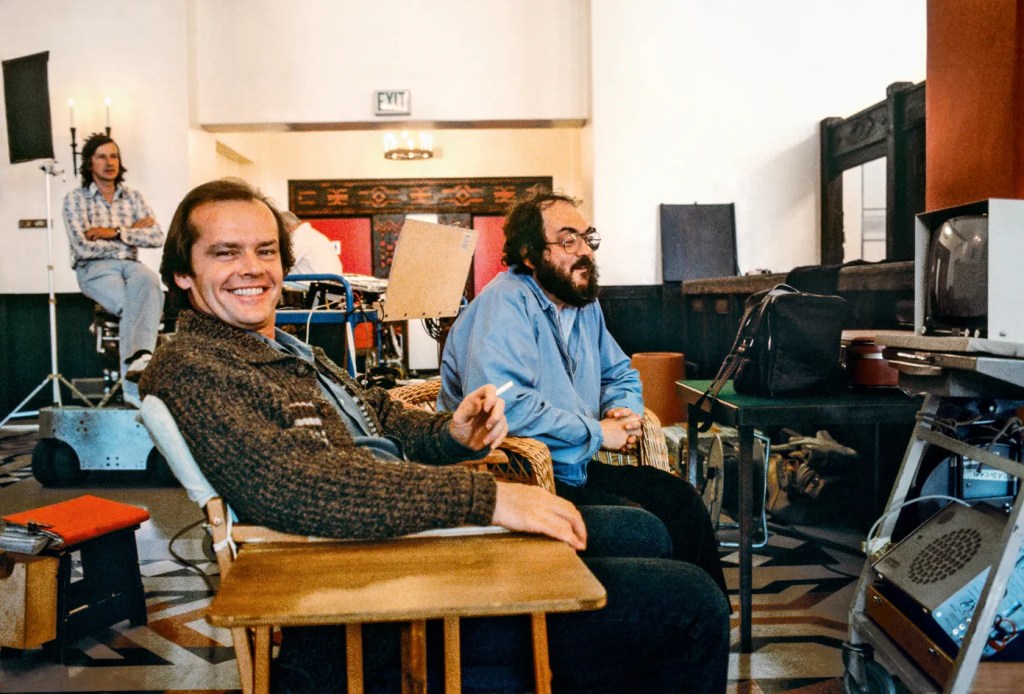
Jack Nicholson and Stanley Kubrick on the set of The Shining (1980).

Watching it about 40 years later, I agree with my teenage-self. It’s a good flick. I’ll never understand why Stanley Kubrick chose to make this particular movie. I’m very curious; it seems like an odd choice for him. Maybe he wanted to prove that even pulp fiction/horror could turn into a movie with artistic merit? If so, Well done.

Much has been written about the film craft on this one, so I won’t go into it much. I liked the way the camera sort of walked around with the characters a lot of the time.

The music was perfect and added a lot, as is so often the case with Kubrick films. And it has that sudden “big finish” that he often uses too.

It’s another 2-and-a-half-hour film, which is pretty typical for Kubrick. I’d have to say I can’t imagine making a better movie out of King’s book. How much of that is Kubrick, and how much Jack Nicholson? Hard to say.

Kubrick’s tenth: “Barry Lyndon”

Two pieces of sabbatical news before my Kubrick review continues. First, I went to court for my civil disobedience back in September. One charge dismissed. Other charges will be dismissed after 28 hours of community service. So that’s good news! The other bit of news is I’m visiting my family in Pennsylvania now. So nice to be here!

Now, on to Kubrick! I did watch this movie, Barry Lyndon (1975) once before, long ago. It was on TV and my father was watching, so I watched it too. I was a teenager. I knew who Ryan O’Neal was, but the name “Stanley Kubrick” didn’t really mean anything to me then. I remember liking it, but thinking it was kind of slow.

Ryan O’Neal and Stanley Kubrick on the set of Barry Lyndon.

I just watched again it the day before yesterday. What a great movie! This has got to be Kubrick’s most underrated film, or least appreciated. I almost never hear anyone talk about this movie, which is strange. It’s one of those movies that you watch and think, “I really want to read the novel!” There’s just so much there.

Ryan O’Neal is perfectly cast in the role, really. He comes across as bright but overly driven by passion and opportunism. As always in a Kubrick film, the music adds a lot. And it’s true; the movie does have a plodding feel — but it feels intentional, and somehow adds to the story of the title character’s life. Somehow the story has shades of Don Quixote for me, but it’s also quite different. I know that doesn’t make sense, but go with it! I highly recommend this film.

Kubrick’s ninth: “A Clockwork Orange”

My sabbatical from First Church Unitarian officially started today, and will end May 19. I’m going to carry on with my Stanley Kubrick review, but a few other posts might come in between Kubrick posts. We’ll see!

Stanley Kubrick on the set of A Clockwork Orange (1971).

This, A Clockwork Orange (1971) was the film I was most dreading. I watched this once before in my life, when I was about 20 years old. At that time, I hated this movie. I loathed the main character, Alex DeLarge, and I didn’t care what happened to him. I thought he deserved whatever he got! So rewatching this film, in some sense, I learned more about how I’ve changed in the last 35 years than anything else.

Watching it now, I see the movie’s brilliance. It’s still not fun to watch. And there is much to loathe about Alex DeLarge, but now my worldview is softer and nuanced enough that I do care what happens to him, and I now am able to take in the main points of the film. It’s very visually stylized in a way that is very Kubrick, but it still feels like a comedown to me after 2001: A Space Odyssey, which I enjoyed so much more.

Kubrick’s eighth: “2001”

I just watched Stanley Kubrick’s eighth feature film, 2001: A Space Odyssey, continuing my deep-dive into Kubrick’s films. This is a film I have watched many times before, but it had been quite a while since the last time. It came out in 1968 (the year of my birth, as it happens). It lasts 2 1/2 hours. It’s a classic for a reason; it’s hard to imagine a more compelling movie, really. And the music! Such perfect use of dramatic classical pieces!

Stanley Kubrick on the set of 2001: A Space Odyssey

A few things really struck me this time around. First, what incredible special effects for 1968! I dare say these were the best special effects set in space up to that point by a wide margin. (Star Wars: A New Hope in 1977 took the next big leap, in my opinion.) Impressive and creative technical filmmaking in 2001 for sure.

I also appreciated the opening scenes more this time around. The first time I watched this movie (in the late 80s, when I was in college), the scenes with the apes in the beginning struck me as boring and ridiculous. For some reason, it didn’t hit me that way at all this viewing. I appreciated the whole monolith storyline that Arthur C. Clarke came up with much more this time. The mimes/actors in the ape suits actually did a great job.

I also appreciated the film-craft of Kubrick more on this viewing. So many great shots… I loved how much ambiguity he left in a key spots, like when Dr. Dave Bowman (Keir Dullea) is alone in the aliens’ strange home for him at the end — when Kubrick shows the passage of time in a very clever way. I also appreciated the intensity and acting of Dullea and wish he had been in more films. (Apparently he has mostly worked in theater.)

And yes, the part with HAL is incredibly memorable and strangely chilling. Hopefully it’s not prophetic.

Kubrick’s seventh: “Dr. Strangelove”

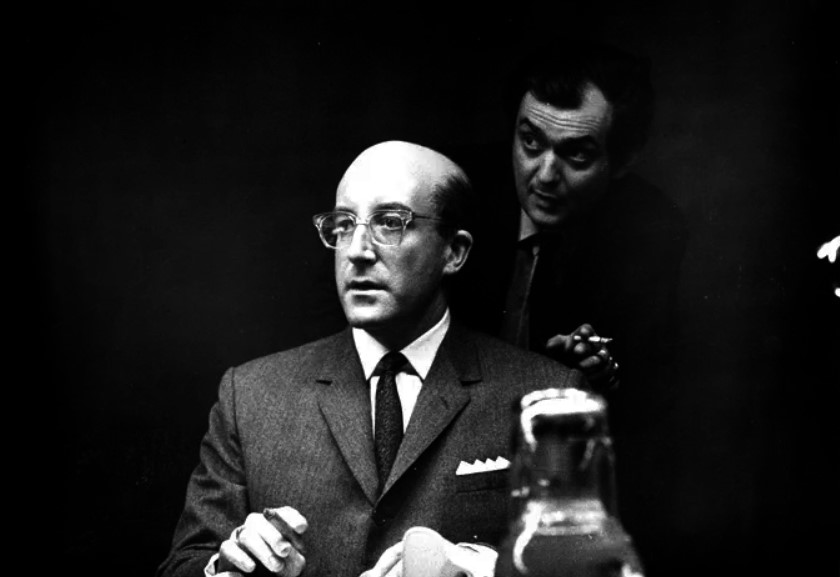
Stanley Kubrick with Peter Sellers, filming Dr. Strangelove (1964).

Kubrick’s seventh feature film was Dr. Strangelove, 1964. I just watched this for the very first time last night. It’s another anti-warm film, but this time it’s a (dark) comedy. It seems to me that this was a very brave and very original film for its time. I was highly entertained for the approximately 90 minutes that the film runs. Peter Sellers plays a few different characters and is brilliant. I also thought George C. Scott was amazing. It’s fun to see a super-young James Earl Jones too, though it’s a small part.

Certainly the paydirt and most memorable part is the last 10 minutes or so. It’s the sort of thing that’s iconic for a reason; once you see it, you’ll never forget it.

It’s a great take on the Cold War. It made me wish that Kubrick had lived long enough to make a film about post-9/11 USA.

Kubrick’s Sixth: “Lolita”

Kubrick on the set of “Lolita”.

Kubrick’s Lolita was so much better than I was expecting. I’d have to say that it’s actually as good as the novel, and that’s pretty rare.

Lolita was released in 1962 (it’s something like 2 1/2 hours long). Because of heavier censorship in those days, the actress (Sue Lyons) cast as Lolita was 14 and 15 during filming (rather than 12 as in the book). She looks more like 16 or 17 years old to me, which makes it somewhat easier to stomach than if she actually looked 12.

Nabokov’s novel is a masterpiece, and I’d say the movie really is too. Kubrick manages to make this movie funny in some moments, and he actually makes you feel bad for Dr. Humbert Humbert (at least up to a point). I suppose you could say that about the novel too, but I felt it more in the movie than in re-reading the book.

As usual, the film craft is excellent. The acting performances are so strong. James Mason is pretty amazing as Humbert, and he was brave to take the role, too. The film wouldn’t have worked at all without a really strong performance in that role, and Mason nails it.

Because the movie works so well, I’d have to say Kubrick did an incredible job. Yes, the novel is excellent… but not every excellent novel makes an excellent movie. This is a really impressive movie interpretation of a novel. I think the deep dive into the human condition and psychological issues makes this feel like a classic Kubrick film.

Kubrick’s Fifth: “Spartacus”

Kubrick on the set of Spartacus.

This is the first Kubrick film I’m blogging about that I actually saw before this “Kubrick kick” of mine. In fact, I’ve seen it many times. I took four years of Latin from 8th grade through 11th grade, and each year our teacher got us out of our usual classes to watch Spartacus in the auditorium. This was in the early to mid-80s. We always did this just before Winter Break. I think she figured we’d all be excited about the upcoming vacation, so we might as well be antsy while watching a movie that featured some of the things about Roman culture that she’d been teaching us.

I have to admit, as a kid, I found this movie boring. I just couldn’t get into it. Not in four years. I almost would have rather been in classes! Of course, I liked school, so I was a funny kid I guess. I even liked Latin.

Well, I just watched it today for the fifth time. I will say, it was more interesting to me now than when I was a kid. I got into it a little bit… and I certainly appreciated certain things about it. I appreciated Kirk Douglas and Laurence Olivier and Jean Simmons and Tony Curtis. I don’t think I fully appreciated who they were as a kid. Sure, I’d heard of them… but it means more to me now. And of course, when I was a kid, I’d never been to Rome or Italy. I spent three years in Italy when I was in the Navy in my early 20s, and I’ve been to Rome and the entire area pictured in the film many, many times. That makes it easier to get into and appreciate, too.

As far as Kubrick’s craft goes, this was really the first movie at that “Kubrick epic scale” that I think of when I think of his films. Spartacus was released in 1960. In terms of filmmaking craft, there’s much to appreciate. From what I read, Kubrick didn’t have complete artistic control (the first and probably only movie where that was the case). That makes it hard to judge his work because I don’t know what he really wanted to do. It was the first movie of his where I really noticed and appreciated the cinematography — and the soundtrack. The music is very dramatic, and I don’t think the film would have worked without it.

For me the fighting scenes are still boring, but that sort of thing always bores me. The love story between Douglas and Simmons is pretty corny (and fictional, not historical fiction which is what the film is overall). I enjoyed the interpersonal scenes between Olivier and Curtis, which are fascinating from an lgbtq perspective.

I’m trying really hard to think of nice things to say, but overall, in spite of skillful filmmaking, the movie just isn’t my kind of movie, even four decades later. (Okay, now I feel old.) And Kubrick makes wonderful anti-war films, but here the war/violence is “noble” in the sense that it’s hard to argue against slaves fighting a revolution. So that feels off-kilter for a Kubrick film somehow. Also, there is no “psychological thriller” edge anywhere that I can find, and I might miss that the most of all. It comes across as cornball, really.

Plus, three hours? One hour too long.

Kubrick’s fourth: “Paths of Glory”

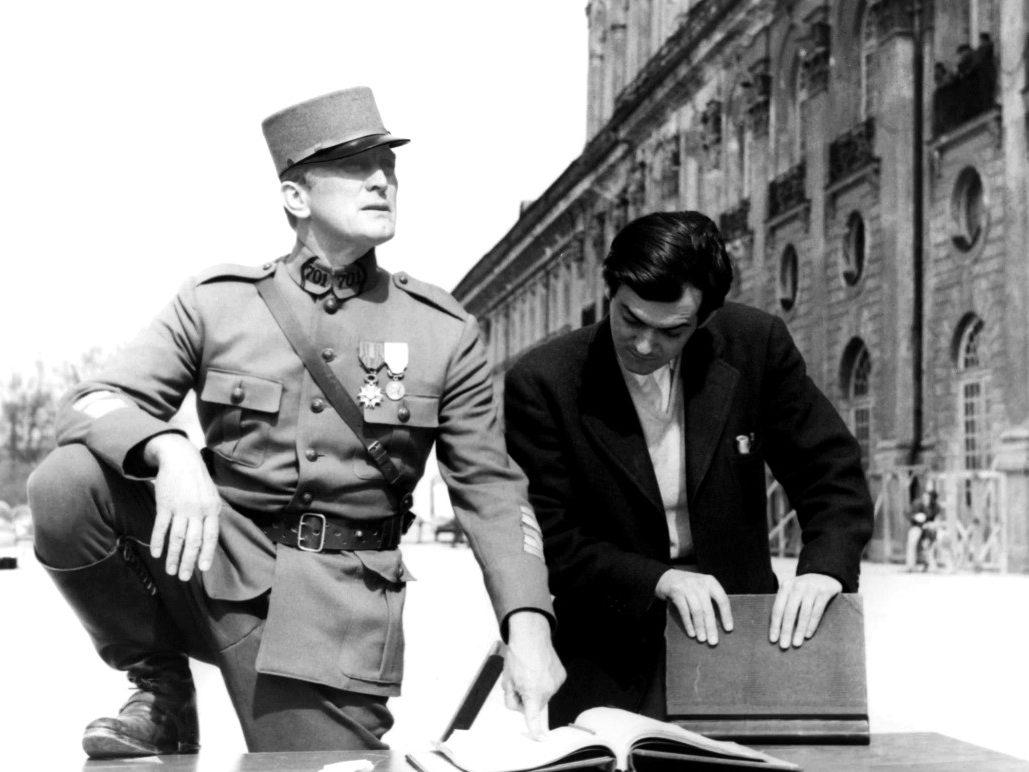
Kirk Douglas and Stanley Kubrick on the set of Paths of Glory

In 1957, Stanley Kubrick’s fourth feature film, Paths of Glory, was released. This is a more typical length at about 90 minutes. It’s another anti-war movie, this time set during World War I, an apparently true story about French soldiers being court martialed for “cowardice”, punishable by death.

For me, this feels like Kubrick’s first fully realized movie. The story is more fully formed, and Kirk Douglas always adds gravitas. The scenes in the trenches are really well done, cinematically speaking. Apparently it was miserable to make this movie, which probably adds realism to what was an especially miserable war. It’s not a fun watch, either… it’s a sad story with an ending to match. But watching it is almost like reading a good classic novel; it’s sad, but somehow uplifting because it feels like worthy art, capturing important parts of the human condition.