Kubrick’s Lolita was so much better than I was expecting. I’d have to say that it’s actually as good as the novel, and that’s pretty rare.
Lolita was released in 1962 (it’s something like 2 1/2 hours long). Because of heavier censorship in those days, the actress (Sue Lyons) cast as Lolita was 14 and 15 during filming (rather than 12 as in the book). She looks more like 16 or 17 years old to me, which makes it somewhat easier to stomach than if she actually looked 12.
Nabokov’s novel is a masterpiece, and I’d say the movie really is too. Kubrick manages to make this movie funny in some moments, and he actually makes you feel bad for Dr. Humbert Humbert (at least up to a point). I suppose you could say that about the novel too, but I felt it more in the movie than in re-reading the book.
As usual, the film craft is excellent. The acting performances are so strong. James Mason is pretty amazing as Humbert, and he was brave to take the role, too. The film wouldn’t have worked at all without a really strong performance in that role, and Mason nails it.
Because the movie works so well, I’d have to say Kubrick did an incredible job. Yes, the novel is excellent… but not every excellent novel makes an excellent movie. This is a really impressive movie interpretation of a novel. I think the deep dive into the human condition and psychological issues makes this feel like a classic Kubrick film.
This is the first Kubrick film I’m blogging about that I actually saw before this “Kubrick kick” of mine. In fact, I’ve seen it many times. I took four years of Latin from 8th grade through 11th grade, and each year our teacher got us out of our usual classes to watch Spartacus in the auditorium. This was in the early to mid-80s. We always did this just before Winter Break. I think she figured we’d all be excited about the upcoming vacation, so we might as well be antsy while watching a movie that featured some of the things about Roman culture that she’d been teaching us.
I have to admit, as a kid, I found this movie boring. I just couldn’t get into it. Not in four years. I almost would have rather been in classes! Of course, I liked school, so I was a funny kid I guess. I even liked Latin.
Well, I just watched it today for the fifth time. I will say, it was more interesting to me now than when I was a kid. I got into it a little bit… and I certainly appreciated certain things about it. I appreciated Kirk Douglas and Laurence Olivier and Jean Simmons and Tony Curtis. I don’t think I fully appreciated who they were as a kid. Sure, I’d heard of them… but it means more to me now. And of course, when I was a kid, I’d never been to Rome or Italy. I spent three years in Italy when I was in the Navy in my early 20s, and I’ve been to Rome and the entire area pictured in the film many, many times. That makes it easier to get into and appreciate, too.
As far as Kubrick’s craft goes, this was really the first movie at that “Kubrick epic scale” that I think of when I think of his films. Spartacus was released in 1960. In terms of filmmaking craft, there’s much to appreciate. From what I read, Kubrick didn’t have complete artistic control (the first and probably only movie where that was the case). That makes it hard to judge his work because I don’t know what he really wanted to do. It was the first movie of his where I really noticed and appreciated the cinematography — and the soundtrack. The music is very dramatic, and I don’t think the film would have worked without it.
For me the fighting scenes are still boring, but that sort of thing always bores me. The love story between Douglas and Simmons is pretty corny (and fictional, not historical fiction which is what the film is overall). I enjoyed the interpersonal scenes between Olivier and Curtis, which are fascinating from an lgbtq perspective.
I’m trying really hard to think of nice things to say, but overall, in spite of skillful filmmaking, the movie just isn’t my kind of movie, even four decades later. (Okay, now I feel old.) And Kubrick makes wonderful anti-war films, but here the war/violence is “noble” in the sense that it’s hard to argue against slaves fighting a revolution. So that feels off-kilter for a Kubrick film somehow. Also, there is no “psychological thriller” edge anywhere that I can find, and I might miss that the most of all. It comes across as cornball, really.
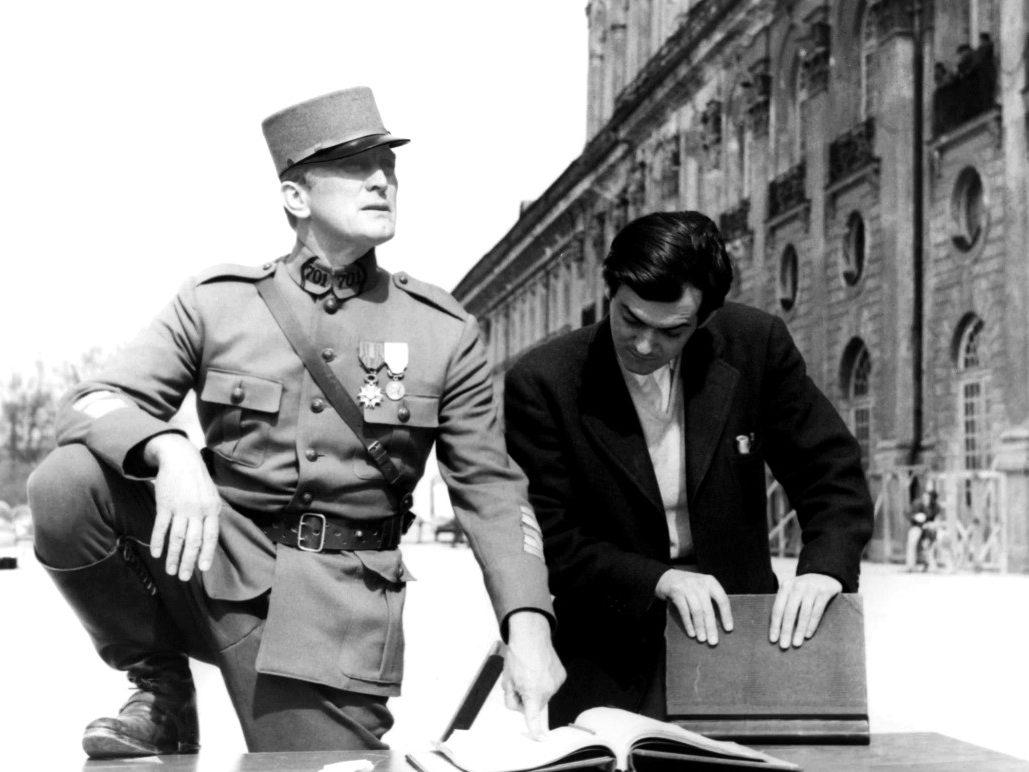
Kirk Douglas and Stanley Kubrick on the set of Paths of Glory
In 1957, Stanley Kubrick’s fourth feature film, Paths of Glory, was released. This is a more typical length at about 90 minutes. It’s another anti-war movie, this time set during World War I, an apparently true story about French soldiers being court martialed for “cowardice”, punishable by death.
For me, this feels like Kubrick’s first fully realized movie. The story is more fully formed, and Kirk Douglas always adds gravitas. The scenes in the trenches are really well done, cinematically speaking. Apparently it was miserable to make this movie, which probably adds realism to what was an especially miserable war. It’s not a fun watch, either… it’s a sad story with an ending to match. But watching it is almost like reading a good classic novel; it’s sad, but somehow uplifting because it feels like worthy art, capturing important parts of the human condition.
I’m on a roll. I just watched Stanley Kubrick’s third movie, The Killing. This is another film noir, this time with a “big heist” theme. I found this far more entertaining than his second movie, another film noir, Killer’s Kiss. And this, like his first two movies, is also just a bit longer than an hour. I still think Fear and Desire (his first film) is the most interesting of his early attempts and feels the most like a Kubrick film (though “rougher” than his later work). Kubrick apparently considered The Killing to be his first more mature effort, and perhaps that’s true in a “filmmaker’s craft” sort of way. It just isn’t all that compelling of a story. Again, Fear and Desire, for me, is the most compelling of the first three films. I’m looking forward to watching his fourth movie, which I hope feels more like the mature Kubrick that I know and love.
Continuing my Stanley Kubrick deep dive, I just watched his second film, Killer’s Kiss. This is a film noir from 1955, just a bit longer than an hour. The main character is a boxer; I have a soft spot for boxing movies that probably comes from watching Rocky as a kid. My favorite thing about the film, aside from the general “noir-ness” of it, is the really interesting and unusually shot boxing scenes. Kubrick wrote this story, which I have to confess I found underwhelming. I thought his first film (Fear and Desire) was far more interesting as a psychological thriller. But visually I can see the improvements from first movie to second. Overall, though, Fear and Desire was a better watch, and felt more like Kubrick to me.
Sometimes I go down a rabbit hole. It usually starts out randomly. In this case, I was reading an article about Christmas movies that aren’t really Christmas movies, but are set during Christmastime. One of these movies, maybe the least Christmas-y of all, is Eyes Wide Shut, Stanley Kubrick’s last film. I remember seeing that movie in the theater. It got very mixed reviews. I remember that it was very creepy, but strangely compelling. I’ve watched it several times over the years, and like most Kubrick films it has all sorts of details that you can’t notice the first time you watch it. I think it’s very underrated. I consider it to be one of Kubrick’s best.
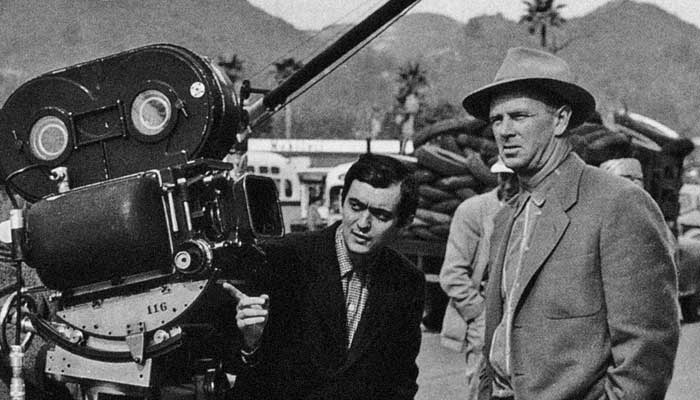
Filming Fear and Desire, Kubrick to right.
But now I’m determined to watch all of Kubrick’s movies in chronological order. The first is a 1952 film, just an hour long. It’s called Fear and Desire, and it’s a (not surprisingly) anti-war (not surprisingly) psychological thriller of sorts. It reminds me of The Twilight Zone, but of course it predates that show. I wonder if Rod Serling was influenced by it at all?
If you like, you can watch it online for free at this link.
I love the opening narration (not written by Kubrick):
There is a war in this forest. Not a war that has been fought, nor one that will be, but any war. And the enemies who struggle here do not exist unless we call them into being. This forest then, and all that happens now is outside history. Only the unchanging shapes of fear and doubt and death are from our world. These soldiers that you see keep our language and our time, but have no other country but the mind.



 Fool of Spirit